
Injection Molding
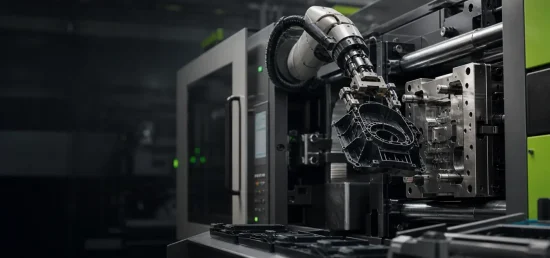
Plastic injection molding on injection-molding machines for customer production requirements.
We manufacture products that require consistent molding of plastic parts to agreed technical parameters.
Need a Production Assessment?
Send a drawing, 3D model, sample or short description. We will clarify the parameters and advise on the next steps.
Injection Molding
What Is Injection Molding?
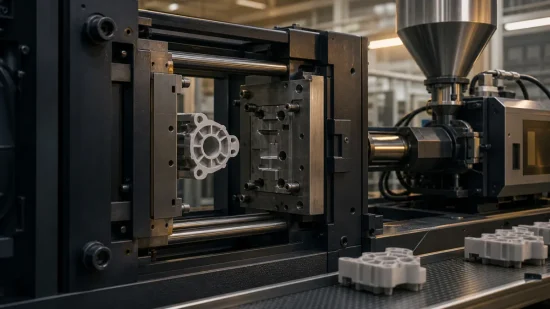
Injection molding is a production method for manufacturing repeat plastic parts with complex geometry. Molten polymer is injected into a closed mould, cooled and removed as a finished part.
The method is designed for repeatability and can reduce the amount of subsequent machining or manual finishing required.
Process
Process Stages
A typical injection-molding cycle consists of four stages.
01
Material Melting
Plastic granules are fed into the injection-molding machine and heated to a uniform melt.
02
Mould Filling
The molten polymer is injected into the closed steel mould and fills its cavities.
03
Cooling
The mould is cooled and the polymer solidifies in the required geometry.
04
Part Ejection
The mould opens, the part is ejected and the production cycle begins again.
Benefits
Benefits of Injection Molding
The initial mould requires preparation, but repeat production offers clear benefits for suitable parts and batch sizes.
- Consistent part geometry based on the mould cavity.
- Repeatability throughout serial production.
- A controlled surface finish determined by the mould.
- Limited need for subsequent processing for suitable products.
- Improved unit economics as the production batch increases.
Applications
Application Areas
Injection-molded polymer parts are used in many technical and consumer products.
Automotive Production
Trim, buttons, instrument-panel parts, housings and fastening clips.
Electronics and Instruments
Housings, control units, connectors and insulating components.
Mechanical Engineering
Protective covers, polymer gears, bushings, handles and technical containers.
Household Appliances
Shelves, vacuum-cleaner parts, appliance components and housings.
Construction Hardware
Dowels, clips, decorative caps and ventilation components.
Housings and Complex Shapes
Custom boxes, trays and tool cases.
Technology
Types of Injection Molding
The process mode is selected according to the polymer, mould geometry and part requirements. Injection pressure and speed are controlled throughout the filling cycle.
Materials
Materials for Molding
AMF focuses on polymer processing. The material grade is selected according to the part requirements and operating conditions.
Production
AMF Manufacturing Capabilities
The production route is agreed after the drawing, 3D model, sample and material requirements have been reviewed.
Modern Equipment
Injection-molding machines with an injection volume from 90 cm³ to 4,000 cm³.
Production Capacity
Small and larger production orders can be reviewed according to the part and mould.
Moulds
Customer-supplied moulds can be reviewed, with the required adjustments discussed for the specific product.
Quality Control
Parts are checked against the supplied drawings, 3D models or samples.
Serial Production
Pilot and repeat batches can be considered after technical review.
AMF
Working with AMF
Send the drawing, 3D model or sample together with the expected quantity and material requirements. The engineers will review the input data and confirm production feasibility and the next steps.
FAQ
Frequently Asked Questions
Which materials are used for injection molding?
The material is selected for the operating requirements of the part. Typical thermoplastics include ABS, polypropylene, polyamide and polycarbonate.
What are the advantages of injection molding?
The process provides production speed, repeatability, a controlled surface and consistent dimensions for suitable products.
What batch sizes can be produced?
Batch feasibility is reviewed individually according to the part, mould and material.
How is the price calculated?
The calculation depends on the polymer, part geometry, mould, cycle and quantity.
How long does mould preparation and production launch take?
Timing is agreed after the drawing, mould condition and technical requirements have been reviewed.
What tolerances can be achieved?
Achievable tolerances depend on the polymer, mould design, part geometry and process conditions.
Can thin-wall or complex parts be produced?
Feasibility depends on the polymer flow, wall thickness, mould design and part geometry.
Are post-processing operations available?
Additional operations can be discussed as part of the complete production inquiry.