
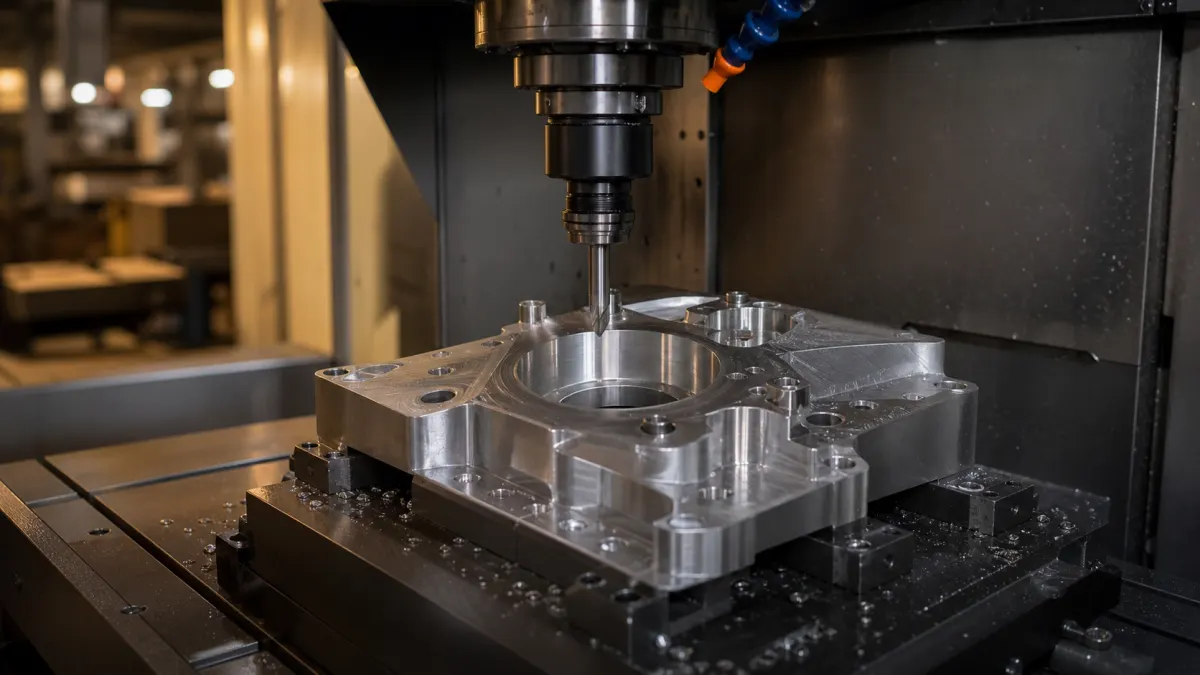
Metalworking
Parts manufactured on CNC equipment from customer drawings, 3D models and technical requirements.
This service is suitable when compliance with design documentation, dimensional consistency and several operations within one production route are important.
Need a Production Assessment?
Send a drawing, 3D model, sample or short description. We will clarify the parameters and advise on the next steps.
Metalworking
What Is Metalworking?
Modern metalworking is a field of precision engineering, software and automated production. In practical terms, it transforms raw metal stock into finished parts and complex working assemblies.
Advanced CNC metalworking uses programmed machining centres to control the complete process. This makes it possible to reproduce geometry and dimensions consistently throughout a production batch.
Production cycle
What Metalworking Includes
Industrial metalworking covers the complete route from raw stock to a part that is ready for assembly. Work may begin with a sketch, detailed drawing or 3D model. Engineers review the input data, select the material and plan the required sequence of operations.
Process
Main Stages
A controlled sequence of operations is essential for dimensional consistency and repeatable quality.
01
Material Preparation
The required metal grade and stock format are selected, such as sheet, calibrated round bar or a casting. The stock is cut to the technological dimensions of the future part.
02
Machining
Milling, turning, drilling and grinding operations create the specified geometry. CNC programs guide the cutting tools along defined coordinates.
03
Heat Treatment
Hardening, annealing or tempering can be used when the material needs specific mechanical properties.
04
Finishing
Fine grinding and polishing remove small surface irregularities and achieve the required finish.
Technologies
Core Metalworking Operations
Different operations can be combined into one production route according to the part geometry and technical requirements.
Laser and CNC Processing
Automated technologies for accurate cutting and machining of parts with complex contours.
Turning
Used for shafts, axles, flanges, bushings and other rotational parts with controlled diameters and lengths.
Milling
Used for housings, slots, gears, flat blanks and complex three-dimensional surfaces.
Drilling and Boring
Produces through-holes, accurate seats and machined internal surfaces.
Grinding
A finishing operation used to achieve a smooth surface and precise dimensions.
Welding and Assembly
Individual metal elements are joined into structures and assemblies ready for further installation.
Equipment
Technology and Equipment
Precision metalworking depends on programmed equipment, stable tooling and controlled production methods.
Modern CNC Machines
Computer-controlled equipment provides repeatability throughout a batch and reduces the influence of manual operations.
High-Precision Machining
Specialised equipment supports complex geometry and demanding dimensional requirements.
Production Automation
Automated processes improve consistency and production efficiency.
Technology benefits
Flexible Production
The production route can be adapted for a single prototype based on a new drawing or for a repeat batch of parts.
Materials
Materials for Metalworking
Cutting conditions, tooling and cooling are selected for the properties of each material.
Result
Benefits of Professional Metalworking
A controlled CNC process provides predictable results for prototypes and serial parts.
- Dimensional accuracy according to the supplied technical documentation.
- Repeatability across a serial production batch.
- Efficient material use and a planned sequence of operations.
- Parts prepared for assembly or subsequent production stages.
Applications
Application Areas
CNC metalworking is used wherever mechanisms, shafts, equipment parts or load-bearing metal structures are required.
Mechanical Engineering
Machine components, gear units, drives and parts for specialised equipment.
Construction
Structural components, heavy-duty fasteners, anchor groups and fittings.
Automotive Production
Chassis, engine and heavy-equipment components.
Equipment Manufacturing
Dies, mould components and production-line parts.
Energy and Industry
Parts intended for demanding pressure or temperature conditions.
AMF Production
AMF Production Capabilities
AMF Production works with customer drawings, 3D models and samples. The team reviews the design, clarifies the material and critical parameters, and plans a suitable production route before work begins.
FAQ
Frequently Asked Questions
Which metalworking operations do you provide?
The available operations include turning, milling, grinding and heat treatment of parts.
Do you work from custom drawings?
Yes. You can provide a drawing, 3D model, working sketch or a sample part for review.
What is the minimum order quantity?
Single parts and serial batches can be considered. The practical minimum depends on the part and production route.
How long does production take?
Lead time depends on geometry, material, required operations and quantity.
Which materials can be processed?
The production team works with ferrous steel, stainless steel, aluminium and non-ferrous alloys such as copper, brass and bronze.
Can you manufacture both prototypes and batches?
Yes. Feasibility and production conditions are reviewed separately for each inquiry.
How is the price calculated?
The calculation considers material, machine time, operations and quantity. Send the drawing or a description for an assessment.