
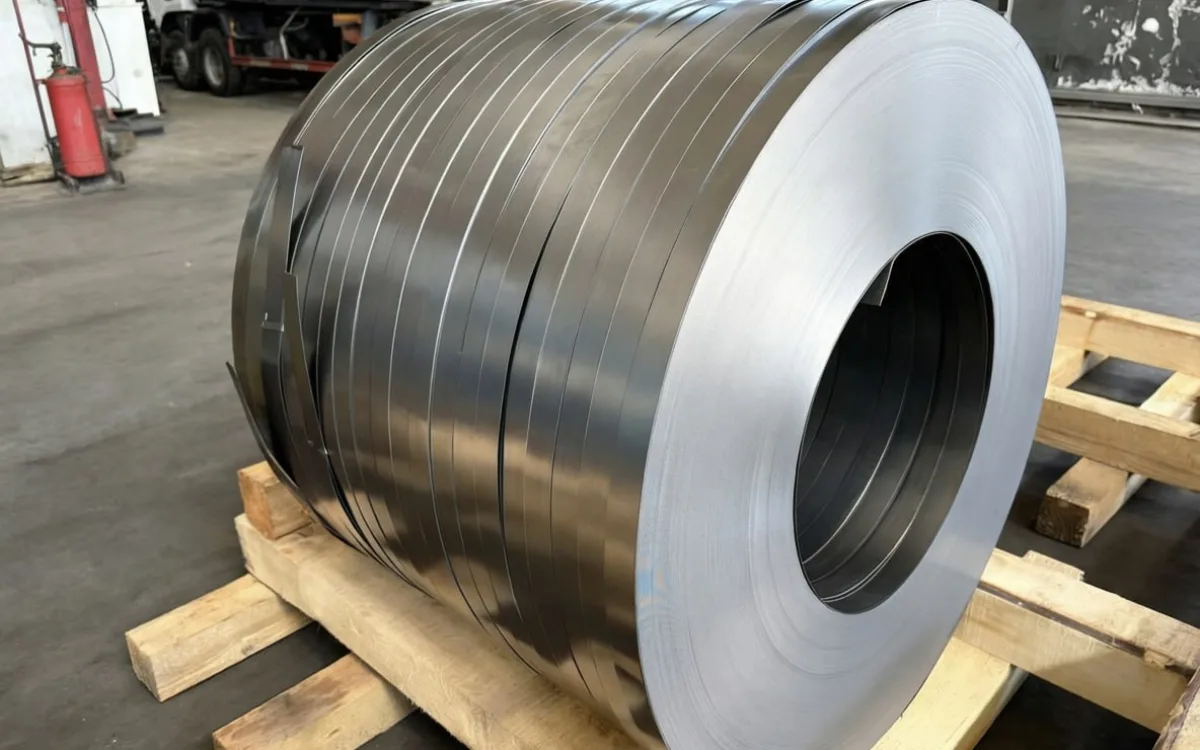
Steel Strip Production
Slitting cold-rolled steel into strip to DSTU for further production and order completion.
We produce strip from cold-rolled steel to the agreed width, batch size and intended application. The service is suitable for manufacturers requiring consistent strip for tube production or other metal components.
Need a Production Assessment?
Send a drawing, 3D model, sample or short description. We will clarify the parameters and advise on the next steps.
Steel strip
Cold-rolled steel strip production
AMF produces strip from cold-rolled steel coil. The source coil is slit longitudinally into agreed widths, and the individual strips are prepared for tube production, roll forming, stamping or component manufacture. We work with AMF steel and customer-supplied coils after checking their parameters.
- Cold-rolled steel.
- Longitudinal coil slitting to specified widths.
- Finished strip or processing of customer material.
- Raw material preparation for electric-welded tube production.
- Agreement of the slitting plan, marking and batch packaging.
Send the coil parameters and required strip list for a quotation tailored to your production task.
What is cold-rolled steel strip?
Strip is narrow steel ribbon produced by longitudinally slitting a coil. Unlike sheet, it already has the working width for the next operation; unlike a finished part, it remains raw material for forming, welding, stamping or assembly.
The terms strip, ribbon and band are often used together, but the supply form matters for quotation. AMF makes cold-rolled strip from coiled steel. Hot-rolled solid flat bar is a different rolled product and is not included in this service.
The practical value of strip is its predetermined width. It can feed a tube, roll-forming or stamping operation according to the customer's process.
Technical capabilities and quotation data
The line's working range depends on source-coil thickness and width, weight, diameters, number of strips and finished-edge requirements. Feasibility is therefore confirmed from the combination of parameters.
| Parameter | What to tell AMF | Why it is needed |
|---|---|---|
| Material | Steel grade, coating and surface condition | To check compatibility with the line and intended use |
| Source coil | Thickness, width, weight, inside and outside diameters | For acceptance, loading and route selection |
| Finished strip | Each strip width and number of coils or weight | To prepare the slitting plan and quotation |
| Edge | Permitted burr and downstream-process requirements | To agree inspection and additional processing |
| Recoiling | Inside diameter, winding density and strip-separation requirements | For reliable feeding into the customer's equipment |
| Order preparation | Marking, packaging and separation by item | For receipt and production launch without re-sorting |
If some information is unknown, send the coil certificate or a photograph of its label and describe the strip's intended use. AMF will verify the parameters against the line and material.
How longitudinal coil slitting works
Longitudinal slitting is a controlled sequence, not simply passing a coil through knives. An error in the slitting plan or material acceptance affects the whole batch, so the route starts by checking the input data.
01
Coil receipt and identification
We compare material, thickness, width, weight, diameters and surface condition with the request.
02
Slitting-plan preparation
Required strips are allocated across the coil width, including agreed process edges and scrap.
03
Loading and threading
The coil is prepared for uniform feeding into the slitting unit.
04
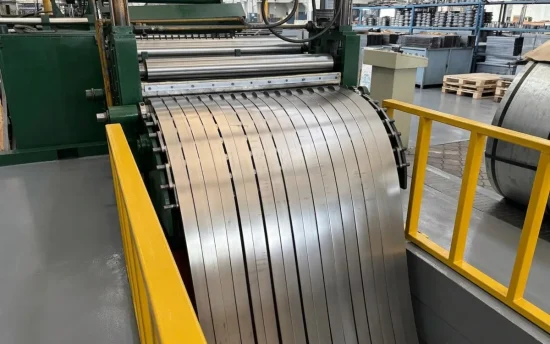
Slitting
The steel is divided lengthwise into strips of the specified width and configuration.
05
Recoiling
Individual strips are formed into coils suitable for storage and subsequent feeding.
06
Inspection
Agreed dimensions and the edge, surface and winding condition are checked.
07
Marking and packaging
Finished coils are separated by item and prepared for collection or the next AMF operation.
The result is a batch linked to a specific slitting plan and production instruction, rather than unidentified strip.
Strip from AMF steel or customer-supplied coil
If the customer has no coil, AMF can produce strip from its own cold-rolled steel. The request should state the grade or intended use, thickness, strip widths, volume and packaging requirements. Material availability and process parameters are confirmed during quotation.
Under the customer-supplied scheme, AMF slits the customer's coil after incoming inspection. Before receipt, the parties agree on:
- steel grade and coating;
- coil thickness, width, weight and diameters;
- width and quantity of each strip;
- permitted process scrap;
- edge and surface-condition requirements;
- recoiling, marking and packaging method.
Provide these parameters before delivery so compatibility can be checked and downtime avoided after the material reaches the workshop.
What steel strip is used for
Strip is rarely the final product. Its value appears in the next operation, so width, edge and winding should reflect the equipment that will receive it.
- Electric-welded tubes. Strip is formed into a round or profiled section and the edges are joined by a longitudinal seam. AMF can combine strip making and electric-welded tube production in one route.
- Roll-formed profiles. Strip is fed through a profiling line and progressively takes the required shape.
- Stamped parts. The ribbon is a continuous blank for serial blanking and forming.
- Furniture and industrial components. Strip is used for frame elements, fastening and connecting parts, and blanks for further processing.
If the application differs, describe it in the request so the technologist can assess edge, surface, winding-direction and packaging requirements.
Steel strip quality control
Checks are linked to the specification and the customer's next operation. Stable feeding matters for a tube line, working width and edge condition for stamping, and surface preservation for a visible part.
Agreed inspection may include:
- strip width and thickness;
- edge condition and burr;
- flatness and camber;
- surface condition after slitting;
- winding density and alignment;
- coil quantity, weight and marking.
If a specific measurement method or results document is required, state this before quotation. Production will confirm which checks and documents can be included.
Standard requirements
If cold-rolled steel strip must comply with a specific DSTU, include the document designation with the steel grade and application. AMF will verify applicability and agree the requirements before production.
This is more precise than a general “DSTU strip” statement. A standard may specify material condition, dimensions, tolerances, surface quality and acceptance rules, all of which must match the actual process and batch documents.
What determines the strip price
Pricing follows review of the coil and slitting plan. Factors include:
- source-metal type, thickness and width;
- required strip widths and quantities;
- total batch volume and number of process passes;
- AMF or customer-supplied material;
- edge, recoiling and inspection requirements;
- marking, item separation and packaging;
- requested completion date.
A price per tonne or batch without these data says little about the actual order. Two equal-weight coils may require different slitting plans and numbers of operations.
How to order steel strip
For an initial quotation, provide a table or email with:
- steel grade, coating and thickness;
- source-coil width, weight and diameters;
- width of each finished strip;
- quantity or weight for each item;
- edge, recoiling, marking and packaging requirements;
- AMF material or customer-supplied coil;
- intended use and requested completion date.
After review, the manager will confirm feasibility and clarify the parameters affecting the slitting plan. Send the specification through the contact form for a quotation.
FAQ
What is steel strip and how does it differ from flat bar?
Strip is narrow ribbon produced by longitudinally slitting steel coil and usually supplied in coils. “Flat steel” is a broader term. AMF produces cold-rolled strip from coiled steel, not hot-rolled solid flat bar.
What material does AMF use for strip?
The base material is cold-rolled steel coil. State the grade, coating and surface condition in the request or customer-coil certificate. Production checks whether it is suitable for the line and intended application.
What strip widths and thicknesses are available?
Feasibility depends on the combination of source-coil parameters and the finished slitting plan. Send coil thickness, width, weight and diameters with the required strip list. AMF checks these against actual equipment capabilities.
Can AMF slit a customer-supplied coil?
Yes, after technical inspection. Before delivery, agree the coil grade, thickness, width, weight, diameters and surface condition, along with strip layout, edge, recoiling and packaging requirements.
Which standard applies to cold-rolled strip?
The standard depends on the application, material and finished-strip requirements. State the required DSTU in the technical specification. Production will verify applicability and agree the parameters and documents for the batch.
What products can be made from strip?
Strip is used for electric-welded tubes, roll-formed profiles, stamped parts, furniture and industrial components. If it will feed different equipment, state the application because it may affect width, edge and winding requirements.
What determines the production price?
The quotation reflects coil parameters and condition, strip widths and count, total tonnage, number of passes, edge, recoiling, marking and packaging requirements, and whether AMF or customer material is used.
What data is needed for a coil-slitting quotation?
Provide the steel grade and thickness, coil width, weight, inside and outside diameters, each strip width and quantity, and edge and winding requirements. Add the intended use and requested completion date.